


Inside a Modern Mechanised Port
Maritime Logistics, Up Close: Inside the Modern Mechanised Port Network of JSW Infrastructure
A port, to the casual observer, is a place where ships arrive and depart. To the industries that depend on it, ports are something far more consequential.
It is the critical junction where global supply chains meet domestic production, where the reliability of cargo handling determines whether a factory runs on schedule or stands idle. Understanding what makes a modern fully mechanised port truly work is, therefore, a window into the port infrastructure that keeps India’s industrial economy moving.
JSW Infrastructure Limited (JSWIL), as a core entity within the JSW Group, operates a network of fully mechanised ports and terminals across the West and East coasts of India. Each coast is designed to deliver the operational excellence and seamless cargo movement that modern trade demands.
The Anatomy of a Modern Mechanised Port
At the core of any modern port operations lies a deceptively simple objective: move cargo from vessel to shore, and from shore to its ultimate destination. Also, this process must be carried out as quickly, safely and cost-effectively as possible. Achieving that objective at industrial scale requires an orchestrated combination of infrastructure, equipment, systems and people.
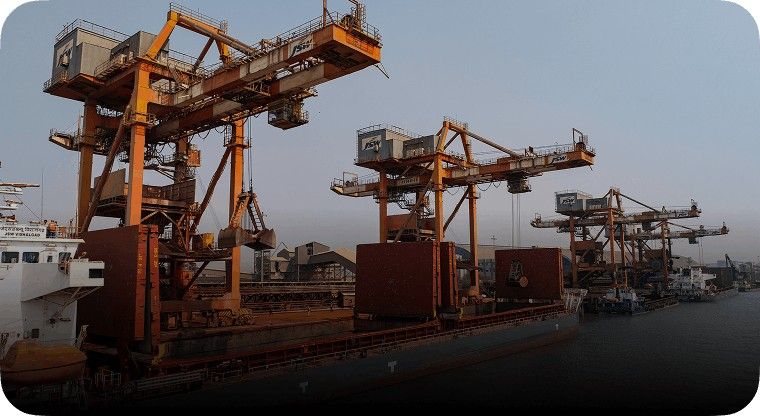
JSW Jaigarh Port, a flagship deep-water facility on the west coast, illustrates this well. Strategically located between the ports of Mumbai and Goa, this all-weather port is equipped with seven berths and a cargo handling capacity of 55 MTPA. When a vessel arrives, potentially a Capesize carrier laden with coal or iron ore, the process that unfolds is anything but routine. Five ship unloaders work in coordinated sequence to discharge bulk cargo directly onto covered conveyor systems, which carry material to cargo storage yards with a combined capacity of over 1.35 million tonnes.
Dust suppression systems operate continuously to manage environmental impact, whilst six ship loaders stand ready to load outbound cargo with equal efficiency. Liquid cargo is handled separately through eight dedicated tanks, and four mobile harbour cranes provide the flexibility to manage varied cargo types as vessel requirements change.
Rail Integration: Completing the Corridor
A mechanised berth for today is only as effective as the infrastructure connecting it to the hinterland. Cargo that moves swiftly from vessel to shore but then sits waiting for onward transport creates a bottleneck that undermines the entire value chain. This is why rail-road evacuation connectivity is as central to modern port operations as the handling equipment itself.
Jaigarh Port sits 55 kilometres from Ratnagiri on the Konkan Railway network. On September 2024, JSW Infrastructure signed a binding Memorandum of Understanding with Konkan Railway Corporation Limited for the construction and development of the Bhoke Railway Siding. Upon completion, this will establish direct railway access to the port, enabling bulk and clean cargo movement to and from the hinterland with significantly greater speed and lower cost. The project is a meaningful infrastructure investment that will strengthen Jaigarh’s position as a third-party cargo hub across Maharashtra and Karnataka.
On the east coast, the Company’s terminals at Paradip serve a similarly strategic function, situated in close proximity to coal and iron ore mines in Odisha. The geographic positioning of these ports across both coasts is itself a form of logistical efficiency, reducing the distance and cost of overland transport before cargo even reaches the berth.
Digitally Transforming Port Operations
Modern mechanisation addresses the physical challenge of cargo handling, whereas, digital transformation addresses the challenge of orchestration. Ensuring that every cargo movement is managed with the visibility and coordination that complex, high-volume operations demand.
JSWIL is actively engaged in digitally transforming port operations across its network, deploying systems that improve vessel scheduling, optimise berth utilisation and provide real-time cargo tracking for customers. These capabilities are the foundation of the end-to-end supply chain solutions that customers increasingly expect from a modern port and logistics company. In a supply chain where delays carry direct commercial consequences, the ability to offer digital transparency and predictive scheduling is an innovation-led growth differentiator.
Sustainability Built into Operations
The modern mechanised port is also, increasingly, a sustainable one. The Company’s commitment to sustainable port operations and responsible growth is embedded in how its facilities are designed and run. Every practice from the materials used in construction to the systems deployed in daily operations is embedded sustainably. This commitment has earned the Company meaningful recognition from credible, independent bodies:
-
Dharamtar Port: Recipient of the 24th Global Environment and Sustainability Award 2025 in the Port sector, awarded by the Greentech Foundation
-
JSW Infrastructure Limited: Awarded a Leadership Grade (A-) in CDP’s 2024 Supplier Engagement Assessment. Reflecting the Company’s systematic approach to decarbonisation and environmental stewardship
These recognitions reflect a sustained, organisation-wide commitment to ESG governance and sustainable infrastructure. Ensuring that every port and terminal meets the environmental standards that responsible growth demands.
The Standard for Port-Led Growth
JSW Jaigarh Port, the Paradip terminals, and the wider network operated by JSW Infrastructure together reflect a clear approach to port-led development. These assets are fully mechanised and function as integrated nodes within the national supply chain, designed for efficient cargo handling and seamless connectivity. Their operations are aligned with ESG standards and a focus on sustainable growth, which are increasingly central to modern infrastructure.
For the JSW Group and India’s industrial ecosystem, this operational capability supports a broader objective. With capacity expansion underway, the Company is strengthening the infrastructure required to support future growth. This expansion is aimed at improving scale, efficiency and reliability, forming the basis for the next phase of port-led industrial development in India.


